Does It Need You? Does It Drain You?
Two years ago I built a 2x2 for deciding what to hand over to AI, a delegation matrix with two questions on it. Coaches use it and their week changes. Last week I put it on a slide for a leadership conference and it died in front of me.
Not the idea. The label. I'd called it the Value-Drain Matrix, and a leader who reads "the Delegate quadrant of the Value-Drain Matrix" has to learn my words before they can use my thinking. I was charging them a tax at the door and calling it teaching.
So here it is with my names taken off. It's yours, and you can use it this afternoon.
The two questions
Take any task you did last week and ask two things about it.
Does it need you? Not could you do it. Does it need your judgment, your relationship with the person on the other end, your read on what's actually going on.
Does it drain you? Does it cost you more energy than it gives back.
Two questions, four combinations, and every task you own lands in one of them. That's the whole delegation matrix.
What goes where on the delegation matrix
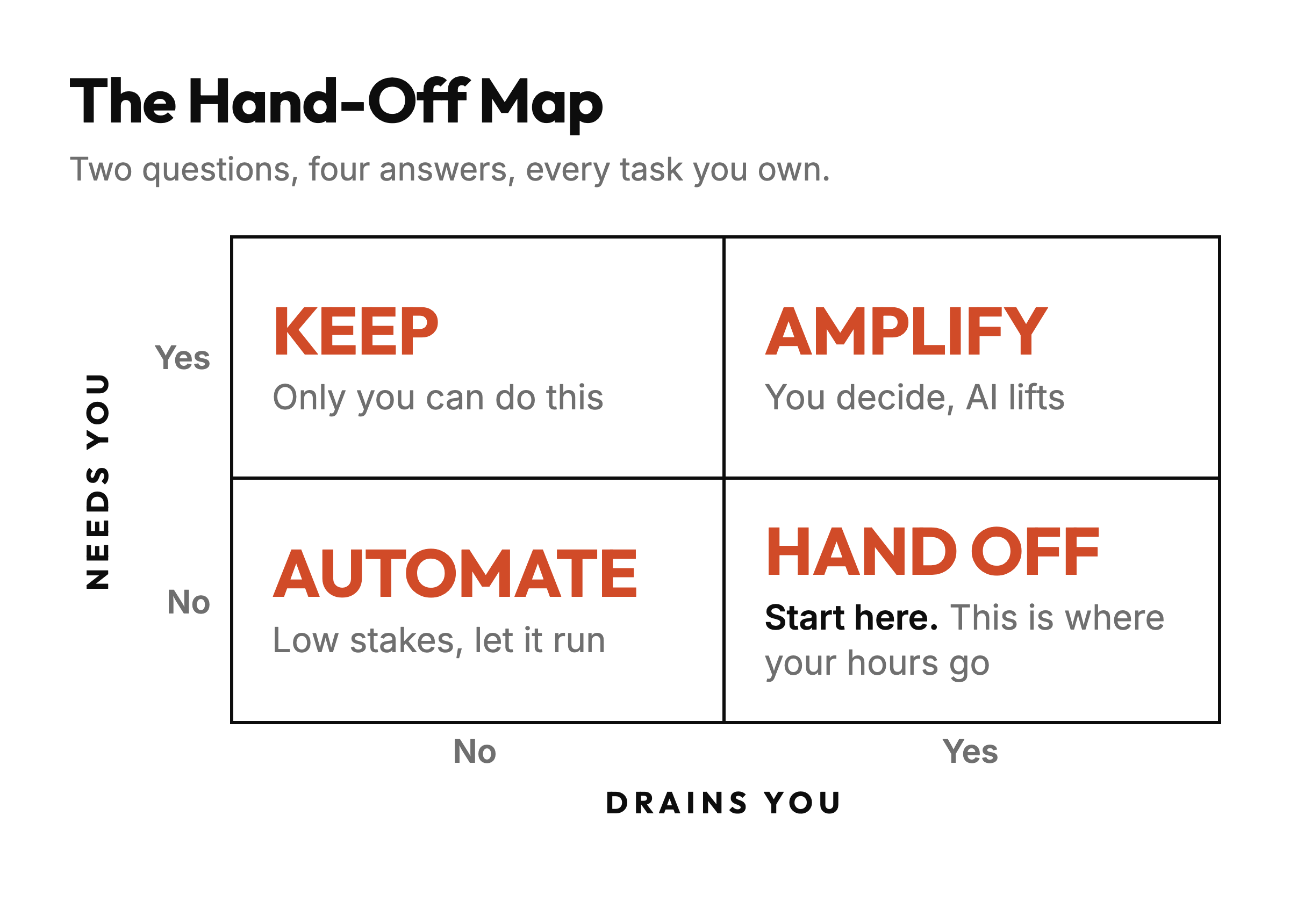
Needs you, doesn't drain you. This is the work. The coaching conversation. The call where you say the thing nobody else will say to them. The half hour where you actually think. Everything else in this post exists to buy you more hours in here.
Needs you, drains you. Your judgment is required and the process is exhausting. Preparing for a session by rereading six months of notes. Writing a proposal for a complicated client. Don't hand these over. Point AI at the draining part and stay in the deciding part. It pulls the history together, you say what it means.
Doesn't need you, doesn't drain you. Scheduling. Filing. Chasing an invoice. Automate it when it's convenient and don't think about it much. This is where most people start, and it's the least valuable place to start.
Doesn't need you, drains you. Start here. The weekly report nobody reads closely. First-pass research. Transcribing and tagging your own recordings. This is where your hours are going, and it's where AI pays for itself inside a fortnight.
Start in the bottom right
The pull is to automate whatever's easiest to automate. Go at what's costing you instead.
Almost everyone I work with has the same experience when they do this honestly. The list of things that don't need them is longer than they expected, and a good chunk of it is work they'd have described as important the day before. Not because it's unimportant. Because it doesn't need them specifically, and they'd never separated those two things.
Putting it on a grid forces that split, which is the entire point of the exercise.
The mistake that costs the most
Delegating out of the top left.
AI can write the client email. It can draft the feedback. It can summarize the session and produce something that reads fine. Can was never the question. The question is whether that task is where your value actually lives, and if it is, capability is irrelevant.
I wrote about this in more depth in The Human in the Loop Is the Bottleneck. The short version is that you decide what stays human in advance, on purpose, and you write it down before you deploy anything, and then the grid sorts everything that's left.
Run it on last week, not on next week
Don't do this as a planning exercise. Open your calendar and your sent folder, take the actual tasks from the last seven days, and place them.
Categories lie. "Client communication" sits nowhere on this grid because half of it needs you and half of it is a scheduling email. Break it up until each thing is small enough to answer both questions about.
Then pick one item from the bottom right and hand it over this week. One. The list will still be there.
What renaming it taught me
For the leaders, I changed every word and left the grid alone.
The axes became the two questions above. The quadrants became verdicts instead of categories. KEEP, AMPLIFY, AUTOMATE, HAND OFF. On stage it's called the Hand-Off Map and my original name for it doesn't appear anywhere in the talk. Nothing structural moved, so everyone already working from the original version still is.
Renaming it was easy. Suspiciously easy, and that's the part I keep coming back to. The names were never carrying any of the weight. The structure was doing all of it.
Which gives you a test for your own work.
Take a framework, a method, a package, a process you named. Strip out every invented term. The acronym, the capitalized stage names, the phrase you'd put on a t-shirt. Replace each one with the plainest description of what that part does, in words your clients already use.
Then look at what's left. If it still stands up and still tells someone what to do on Monday, you built a framework, and the names were packaging you can change per audience for free. If it falls apart once the terminology isn't holding it together, you had a vocabulary. Better to find that out on a Tuesday afternoon than in front of a paying audience.
Why I'm giving you the whole thing
Because a named model isn't evidence of anything anymore.
Anyone can generate a plausible five-part framework with an acronym and a matching diagram in about thirty seconds now. The packaging layer is free, and free things stop proving anything about the work behind them. What's left that's worth having is a structure that survives losing its name, and you only get one of those by watching something work with real people enough times to know which parts are load carrying.
So take the grid. Call it a delegation matrix, call it the Hand-Off Map, rename it for your own clients if that helps them use it. Put your labels on it. It'll hold.
I still catch myself in the wrong quadrant most weeks, usually something in the bottom right I've talked myself into believing needs me, because doing it feels like working. The grid doesn't fix that. It just makes it harder to pretend.
We're all figuring this out as it arrives, and I don't think that changes.