What is an AI Agent? A Definition for the Rest of Us
An AI agent is a body with four parts: a Brain that reasons, Files that store its memory and your IP, Hands that take action, and a Heartbeat that decides when it runs.
Most definitions you'll find were written for developers. This one is not. The Brain is shared infrastructure that anyone can rent. The Files are private property that no-one else has. That is where the value lives.
Why Most Agent Definitions Don't Help You
Type "what is an AI agent" into a search bar and you get a wall of definitions. I have read most of them. They were written for the people building agents, not the people deploying them.
Anthropic calls an agent an "augmented LLM with tools, memory, and decision logic." OpenAI's Agents SDK has four primitives: Agent, Tools, Handoffs, Guardrails. LangChain breaks an agent into Nodes and Edges and State. Marc Andreessen defines an agent as LLM + Shell + Filesystem + Markdown + Cron. Simon Willison's preferred line: "an LLM agent runs tools in a loop to achieve a goal."
These are good definitions. They are also written entirely for an engineering audience, and I am writing this for a different one.
If you are a coach, a leader, a consultant, or any kind of professional who wants to use agents in your work without becoming a developer, the standard definitions leave you stuck. They tell you what an agent is made of in technical terms (graphs, primitives, scaffolds) without ever telling you what it is in a way you can hold in your head and actually use.
Here is the comparison in one table:
| Source | Their components | Audience |
|---|---|---|
| Anthropic | Augmented LLM, Tools, Memory, Decision Logic | Engineers |
| OpenAI | Agent, Tools, Handoffs, Guardrails | Engineers |
| LangChain | Nodes, Edges, Tools, State | Engineers |
| Andreessen | LLM, Shell, Filesystem, Markdown, Cron | Tech-literate |
| Simon Willison | "LLM running tools in a loop" | Engineers |
| This article | Brain, Files, Hands, Heartbeat | Everyone else |
The mechanics matter. They just don't fit the audience.
An AI Agent is a Body
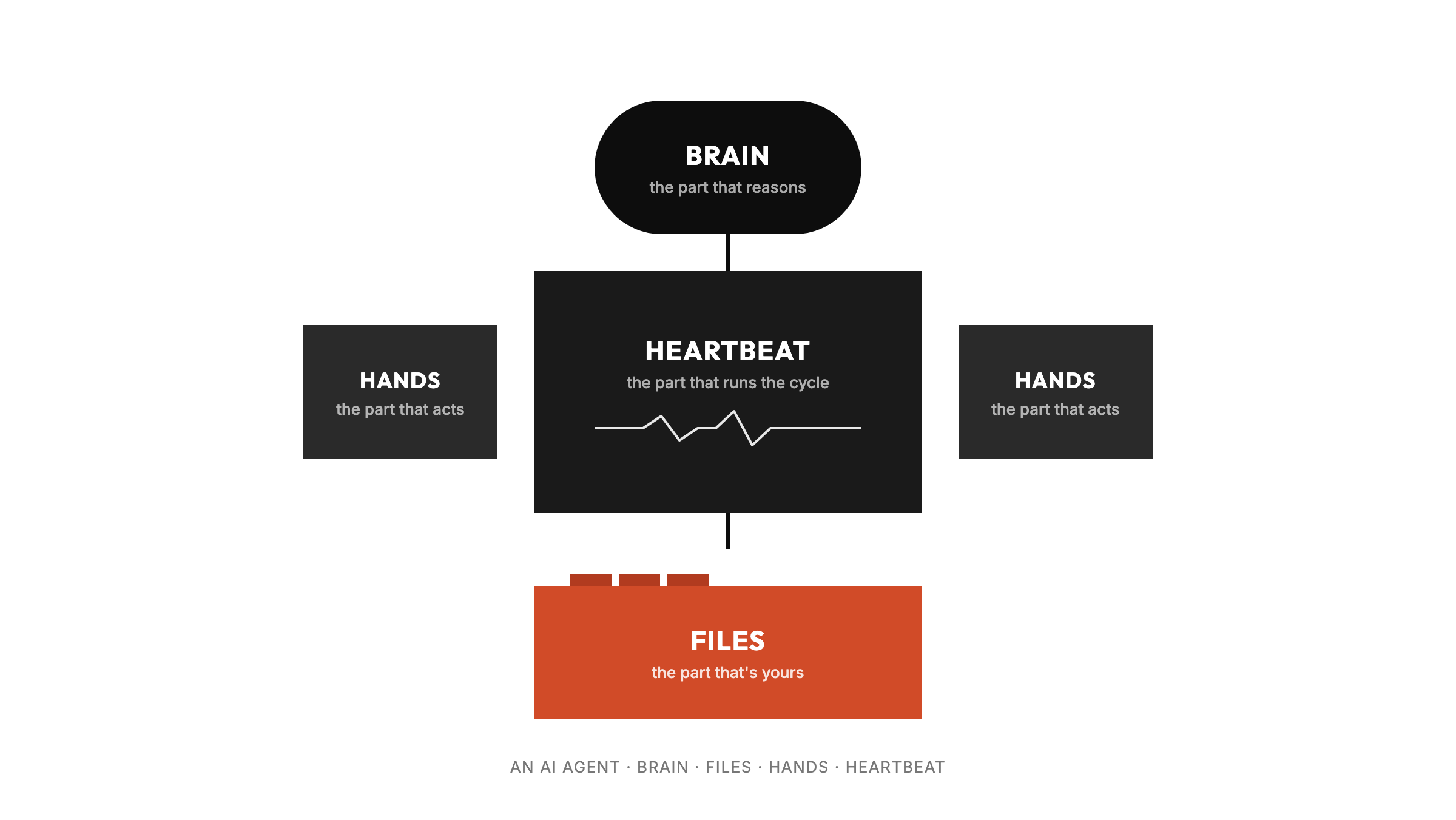
An agent is a body with four parts: a Brain, Files, Hands, and a Heartbeat. The differences between platforms come down to which parts are present and how much you control each one.
Walk through them one at a time.
Brain: the Part That Reasons
The Brain is the large language model. Claude, ChatGPT, Gemini, Llama, Mistral. Whichever you are using right now, that is the Brain.
The Brain takes in language and produces language. It works through problems and produces decisions. When you have a chat conversation with an AI, you are talking to a Brain.
Two things to understand about the Brain.
Brains are interchangeable. The leading models change every six months. The one you are using today will be replaced by something better twice this year. Architecting your AI work around any single Brain is a strategic mistake.
The Brain is a commodity. Every coach using Claude is renting the same Brain as every other coach using Claude. What you bring to the Brain is where you compete.
That is the second part of the body.
Files: the Part That's Yours
The Files are the agent's memory. They are also the agent's home.
When the Brain wakes up, it has no memory of you. No record of yesterday's conversation. It starts as a stranger, every time. The Files are how that changes.
Files are everything the agent reads to know who it is working with: your identity document, your methodology, your project contexts, your active priorities, your accumulated thinking. Stored as plain markdown files on your computer or in cloud storage. Readable by any agent on any platform.
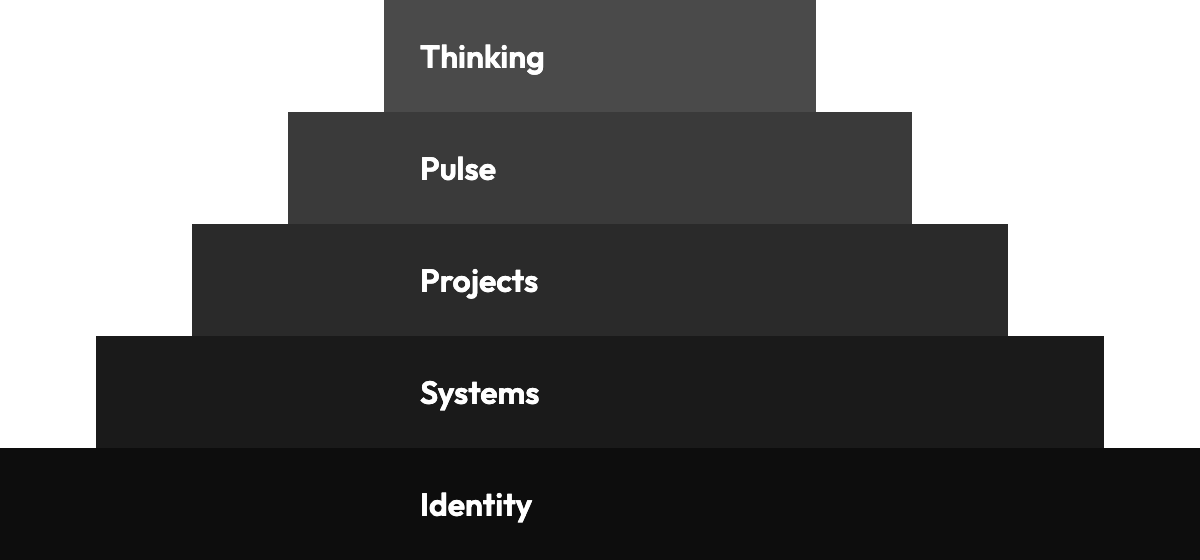
This is where the Human Stack lives. Five folders organised from permanent to fluid: Identity, Systems, Projects, Pulse, Thinking. The Files in each folder shape how the Brain reasons about everything that comes after.
The point most people miss: Files are owned by you. Brains are not.
Every coach using Claude rents the same Brain. What each one brings to it differs: their IP, client work, voice, accumulated thinking. That is the Files.
Here is the cascade:
- Your Files are unique to you.
- Unique Files give the Brain unique context to read on every cycle.
- Unique context produces output only your agent can produce.
- Therefore: the Files are where competitive advantage lives.
A weak Brain on a strong Files library will outperform a strong Brain on no Files. Brains are cheap and improving. Files compound.
I will come back to this. It is the most important point in the article.
Hands: the Part That Takes Action
The Hands let the agent do things in the world.
Send an email, browse a website, edit a file, run code, update your CRM, post to your calendar. Anything that requires the agent to act runs through the Hands.
A pure chat conversation has no Hands. You ask Claude a question, Claude writes you an answer, you copy and paste it somewhere yourself. That is Brain plus Files plus your two hands. The agent has none of its own.
An agent with Hands does the work itself. It opens the file, clicks the button, sends the message. No copy-paste required.
Different platforms give you different Hands. Claude Code gives an agent full shell access, meaning it can do anything you could do at a terminal. ChatGPT's Agent Mode comes with a browser and some tools. Gemini integrates with Google's tools. The Hands are platform-dependent in a way the Brain and Files are not.
Two important rules about Hands.
Hands without Files is dangerous. An agent that can act in the world but has no clear understanding of your context will make confident mistakes. The widely cited failure rate of agentic AI projects (around 92%) is mostly this. Hands wired up before the Files were ready.
Grant Hands deliberately. Every action an agent can take is a permission. Treat them with the same care you would use when hiring a junior team member. Trust the Hands progressively.
Heartbeat: the Part That Runs Without You
The Heartbeat is what makes an agent autonomous instead of reactive.
A reactive agent waits for you to prompt it. You speak, it acts. That is most chat conversations. Useful, but it does not run while you sleep.
An agent with a Heartbeat runs on a schedule: every morning at 6am, every Friday at noon, every time a new email arrives, every time a meeting ends. The Heartbeat is the trigger that says: "wake up, do the thing, go back to sleep."
The Heartbeat is what turns AI from a tool you operate into infrastructure that operates around you.
A note on credit. I didn't invent the word "Heartbeat." Marc Andreessen describes Cron as "the heartbeat" of Pi. MindStudio writes about a Heartbeat Pattern as a design approach. The word is theirs. I am using it as a peer component of the agent itself, alongside Brain, Files, and Hands.
That is the four-part definition: a Brain that reasons, Files that remember, Hands that act, and a Heartbeat that runs the cycle.
Now the harder claim.
The Files Are the Moat
If you read only one section of this article, read this one.
The Brain is shared infrastructure. The Files are private property.
Anthropic, OpenAI, Google, Meta, and a dozen others are spending tens of billions of dollars training the next generation of Brains. Whichever one wins, you will be able to rent it for a few dollars a month. The Brain is becoming a commodity faster than any technology in history.
The Files are not.
Your IP is not in any training dataset. Neither is your client work. Your voice, methodology, way of thinking, decisions, relationships, frameworks. None of it is anywhere a public model can reach. It exists only in the documents you have written and the work you have done.
The agent that knows all of that does not exist anywhere else, and cannot. It is the only part of the agent that is structurally unique to you.
The practical conclusions:
- Brains will keep improving. You can swap to better ones.
- Hands will keep expanding. New platforms will give you new abilities.
- Heartbeats are infrastructure. You wire them once.
- Files compound. They are the only part of your AI work that gets more valuable the longer you do it.
If you are deciding where to invest your attention right now, the answer is the Files. Build them first, and build them with care.
The architecture I use is the Human Stack: five folders, three starter documents, a structured home for everything you think and produce. There is a 30-minute setup walkthrough at colinscotland.com/set-up-your-human-stack.
The principle is independent of any specific structure. Whatever framework you choose, the move is the same. Get your context out of your head and into files an agent can read.
Why the Brain Matters Less Than You Think
The natural objection: surely the Brain matters. Different models have different strengths: Claude for code, Gemini for long documents, ChatGPT for whatever it does best this month. Choosing the right Brain has to be most of the work.
It is a smaller part of the work than you think.
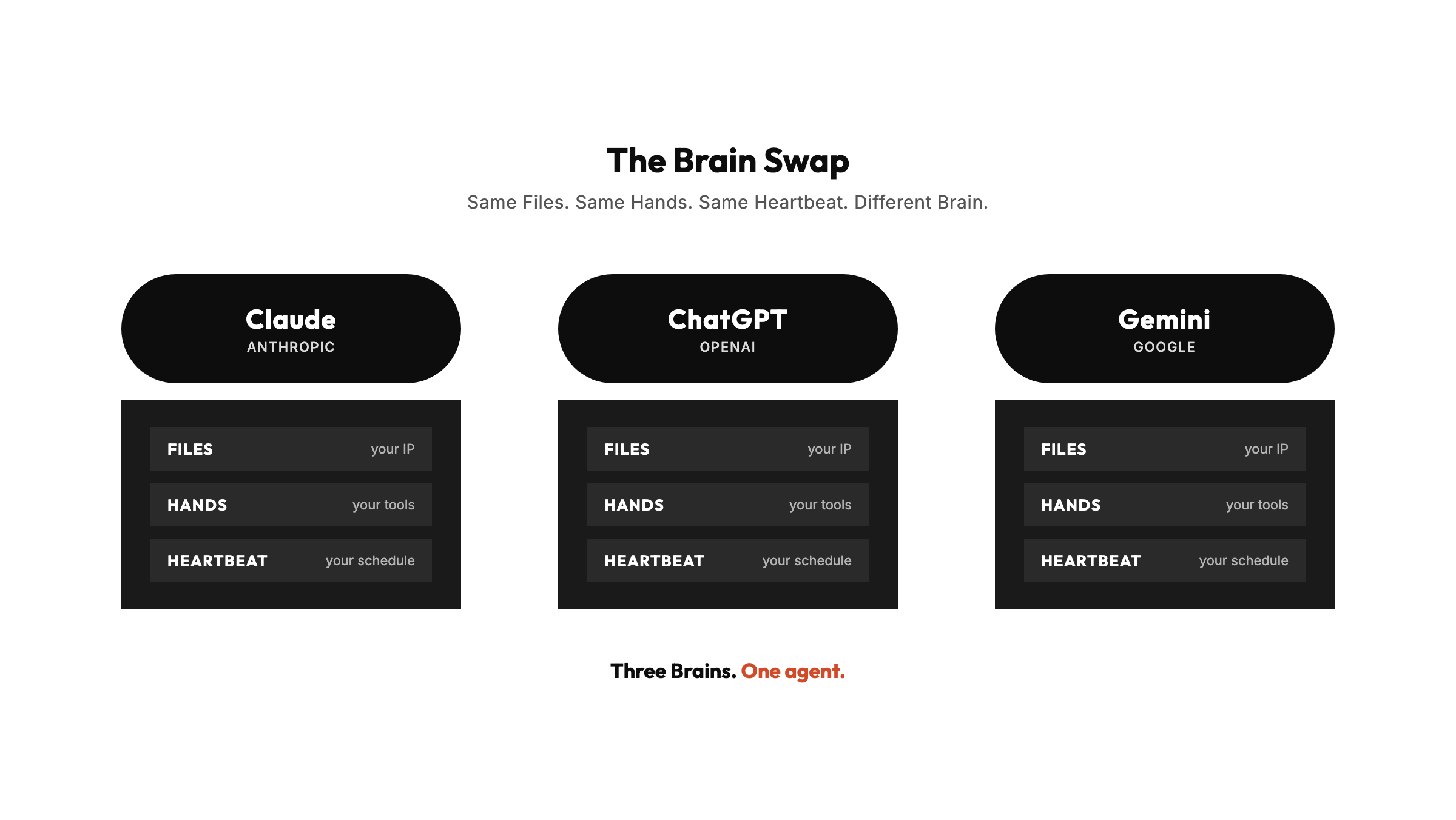
Here is the test. Run the same Files through Claude, ChatGPT, and Gemini. Output quality varies. The voice and judgement you read on the page are yours, because the Files are yours. Three Brains, the same agent.
This is the Brain Swap. It is the operational test of whether your AI work is portable, and the structural reason vendor lock-in is not a problem you have to solve. If your value lives in your Files, and your Files are plain markdown that any agent can read, you are not locked into anyone's platform. You are renting Brains.
The practical implication: when a better Brain comes out (and it will, every six months) you change one configuration setting. Your agent keeps its memory and everything you have built. The output quality steps up. The agent itself stays the same.
This is also why most "AI strategy" advice gets it backwards. The advice is usually about the model: pick the right one, learn its prompts. The actual move is upstream of all of that. Build the Files that make any Brain useful to you, and stop pretending the Brain is the thing.
Where to Start
The four-part definition is enough on its own to make better decisions about agents. When you are evaluating any platform or tool, ask:
- What is the Brain? Which model is doing the reasoning, and can I swap it?
- What are the Files? Where does my context live, and is it portable?
- What are the Hands? What can the agent actually do, and what can I revoke?
- What is the Heartbeat? When does the agent run, and can I change it?
Most products will answer the first and third questions enthusiastically and the second and fourth poorly. That is your signal.
If you are starting to build for yourself, the order matters. Files first. Always.
You cannot build a useful agent on top of nothing. You can build a useful agent on top of a clear identity document, a few systems frameworks, and the contexts of your active projects. That is the minimum viable Files layer. You can sketch it in an afternoon.
The 30-minute walkthrough for setting up your own Files architecture is at colinscotland.com/set-up-your-human-stack. The full architecture is at colinscotland.com/human-stack.
Once your Files are in place, you can wire the rest: a Brain to read them, Hands to act on them, a Heartbeat to run the cadence your work needs. That stack is the subject of the next pillar piece.
For now, build the Files. Everything else is downstream.
Where to Take This Next
If this article gave you the structural picture, my earlier piece AI Agents: What Business Owners Need to Know gives you the operational one. Live use cases, business results from Telus and Danfoss, the trap most business owners are about to fall into, and a practical path to set up your first agent. Read both for the full picture.
If you want to start your Files layer today, the fastest way in is the Amplify OS Builder. It walks you through the questions and produces your ME.md in about ten minutes. That document becomes the first file your agent reads, on whatever platform you use.
For a guided build of the whole stack with live support, the Amplify Intelligence Accelerator is the path.
Use the Amplify OS Builder to write your ME.md in 10 minutes.