Domain Mapping: Find Where AI Fits Before You Build Anything
Before you build anything with AI, map how your business runs. I call it domain mapping, and it's what I teach in Week 5 of the Humane Business AI Accelerator.
If you've ever drawn a customer journey map, you already know most of it. A customer journey map follows your client step by step, from first contact to the end. Domain mapping does the same for the critical processes inside your business. It follows one piece of work from start to finish. At every step it asks who does the work: a person, a person with AI, or AI on its own.
Many owners start AI the other way round. They see an agent that looks useful, then go looking for somewhere to put it. When you add AI to a process nobody has written down, it speeds up whatever is already there, including the steps that shouldn't exist. A map shows you where your people need to stay and where AI can help them. It also shows where AI can do the work while someone checks it.
Here's the method in five steps. The first four need only a pen and paper.
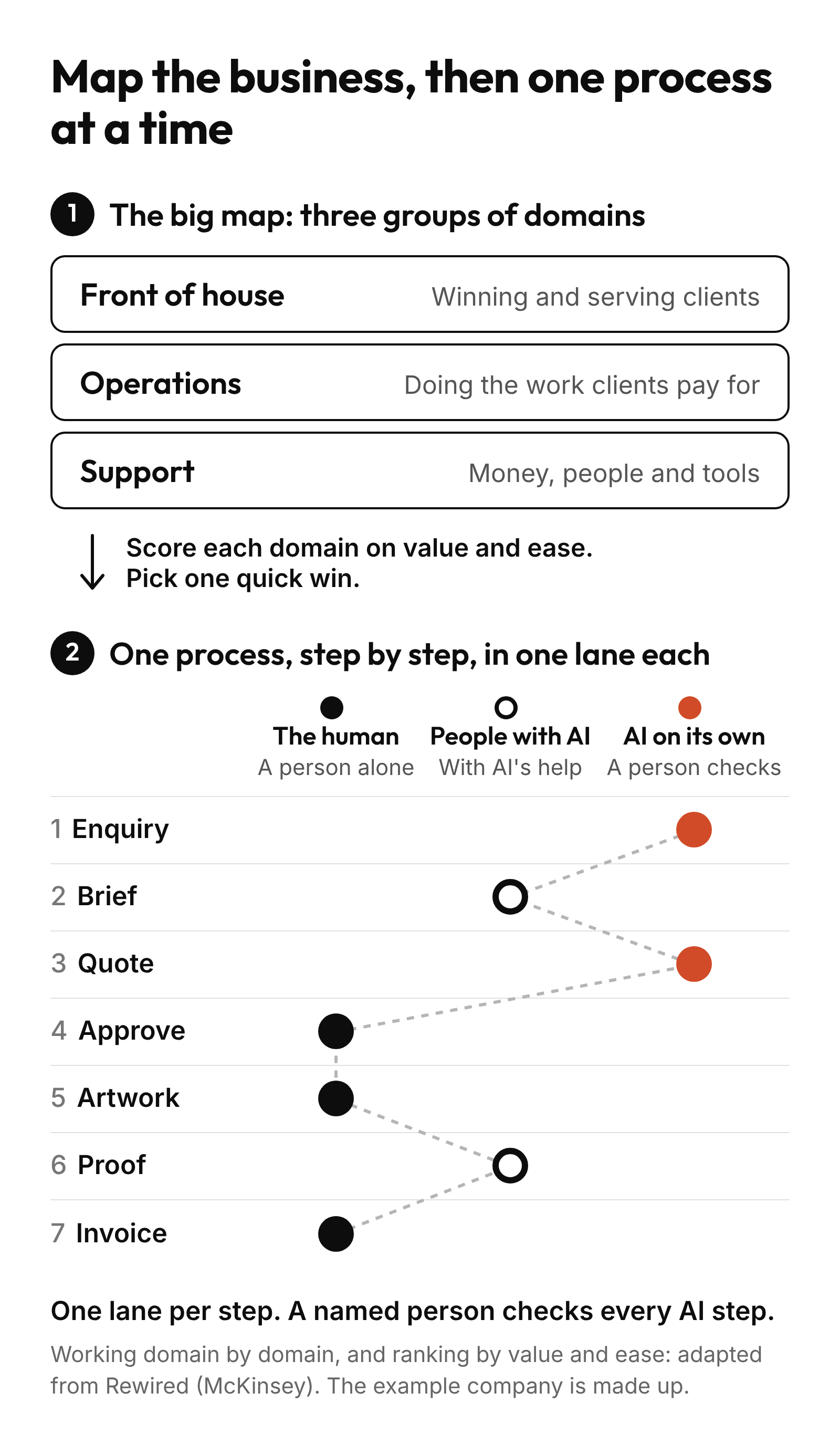
Step one. Split your business into three groups
A domain is one piece of work from start to finish. "From first enquiry to signed order" is a domain. It usually passes through several people on the way.
Every business has three groups of domains.
- Front of house is winning and serving clients.
- Operations is doing the work clients pay for.
- Support is running the business: money, people and tools.
Write two to four domains in each group, each one as "From ___ to ___". Naming where a piece of work starts and ends shows you who it passes between.
The idea of working domain by domain isn't mine. It comes from Rewired, the McKinsey book by Eric Lamarre, Kate Smaje and Rodney Zemmel. So does ranking domains by value and ease, in step two. The three groups, the three lanes and the order of the steps are my own simplification, built for an owner with a small team.
Step two. Score them on value and ease
You can't redesign everything at once, so you choose. Place each domain on a grid. One side is how valuable it would be to improve. The other is how easy it is to act on now.
Value means return on time, return on investment, more clients or less risk. Easy now means you can act on it yourself and the information is already in files, safe to use. It also means your team will use the result, and the work comes round every week.
Start with a quick win, a domain that's high value and easy now. If you're not sure which one that is, look at where your business gets stuck. The work that waits longest usually sits inside one domain, and that's often the one worth the most.
Step three. Map one critical process by hand
Pick one process inside that domain. Keep it to one process, not a whole job. If it takes more than eight steps, split it in two.
Then write it out by hand, with the steps from left to right. For each step, note what happens, who does it today, what information it uses, who decides and where the work waits. Map it as it runs today, workarounds and all. The improvements come later.
Rosario, who co-founded Humane Business with me, argues for doing this part manually first. When you write it yourself, you see what the journey looks like, which steps matter and what the critical path is. You need to understand the system before AI drafts anything for you.
Step four. Put each step in one of three lanes
Under your steps, draw three rows. These are the lanes.
- The human. A person does it alone.
- People with AI. A person does it with AI's help.
- AI on its own. AI does the work, and a named person checks the result.
Put each step in one lane only, even if two people touch it. Pick the lane that does most of the work, and write down who checks it.
Then look at where the work passes from one lane to another, because that's where things wait and get lost. Ask what the map shows that you hadn't written down. The longest wait might sit with someone who doesn't own the process. There might be days in the middle that nobody can account for.
Every step in the AI lanes still has a person attached, and the map makes that visible. Pricing, relationships and judgement calls usually stay in the human lane. Before any AI step touches client details, money or confidential work, decide three things. What can it reach? Can its work be undone? Who approves it? I've written more about that in The Human in the Loop Is the Bottleneck.
Step five. Build the big map, then a map for each process
Now bring AI in. As I told the group in Week 5, "we don't always have to do it longhand or manually."
Give AI your hand-drawn map (a photo works) and whatever it already knows about your business. Ask it to draft the big map, with all three groups and every domain in each. Correct it until it's right. Then map each process in detail, one at a time, with the AI asking you the questions from step three. Ask it to show each map visually.
The goal, in my words from the session, is "to create the big map and then a map for each of the processes so that you understand where AI is going to play its role and how."
Save the maps where your AI can read them next time. They show your team how the business runs, and they give the AI the context it needs. That's the idea behind the Human Stack.
A worked example
Here's a made-up example we use in the Accelerator. Say you run a firm that makes custom boxes for food and drink brands. Front of house holds "from first enquiry to signed order". Operations holds "from artwork in to proof approved" and "from proof approved to boxes shipped". Support holds "from invoice to paid" and "from month end to the monthly numbers".
Enquiry to order is the quick win. Slow quotes lose orders, and the past quotes are already in files.
You map it in seven steps and give each one a lane. Two steps go to AI on its own. An agent flags new enquiries for your sales lead to check, and AI drafts each quote from past quotes while you set the price. Two go to people with AI. Your sales lead takes the brief with AI's help, and your studio lead checks every artwork file with an AI pre-check. Three stay with the human. You approve each quote before it goes out, one named person files the artwork, and your bookkeeper checks the invoice.
The map shows something nobody had written down. Your sales lead owns the process, but the two longest waits sit with you and your studio lead. The first thing to build is the enquiry agent. It's high value, easy now, and a person checks every list it makes.
Where to start this week
Take one sheet of paper. Write your three groups and the domains in each. Pick one quick win, map one process by hand, and put every step in a lane.
None of us has our business fully worked out on paper. One process, mapped by hand, is a good place to begin.
Humane Business is the company I co-founded with Rosario Londoño. If you'd like to do this with us, our AI Sprint is three hours live on Zoom. You leave with a roadmap for 2027, your AI set up with the right guardrails and your first agent working. If you want to map the whole business with your team, domain mapping is a full week of our Accelerator.