Context Engineering: The Two-Way Connection Between You and AI
What actually connects you to AI isn't the chat window. It's the files you keep. That two-way connection between the human and the non-human is where the work happens, and the strength of it decides whether the AI understands you or treats you like a polite stranger.
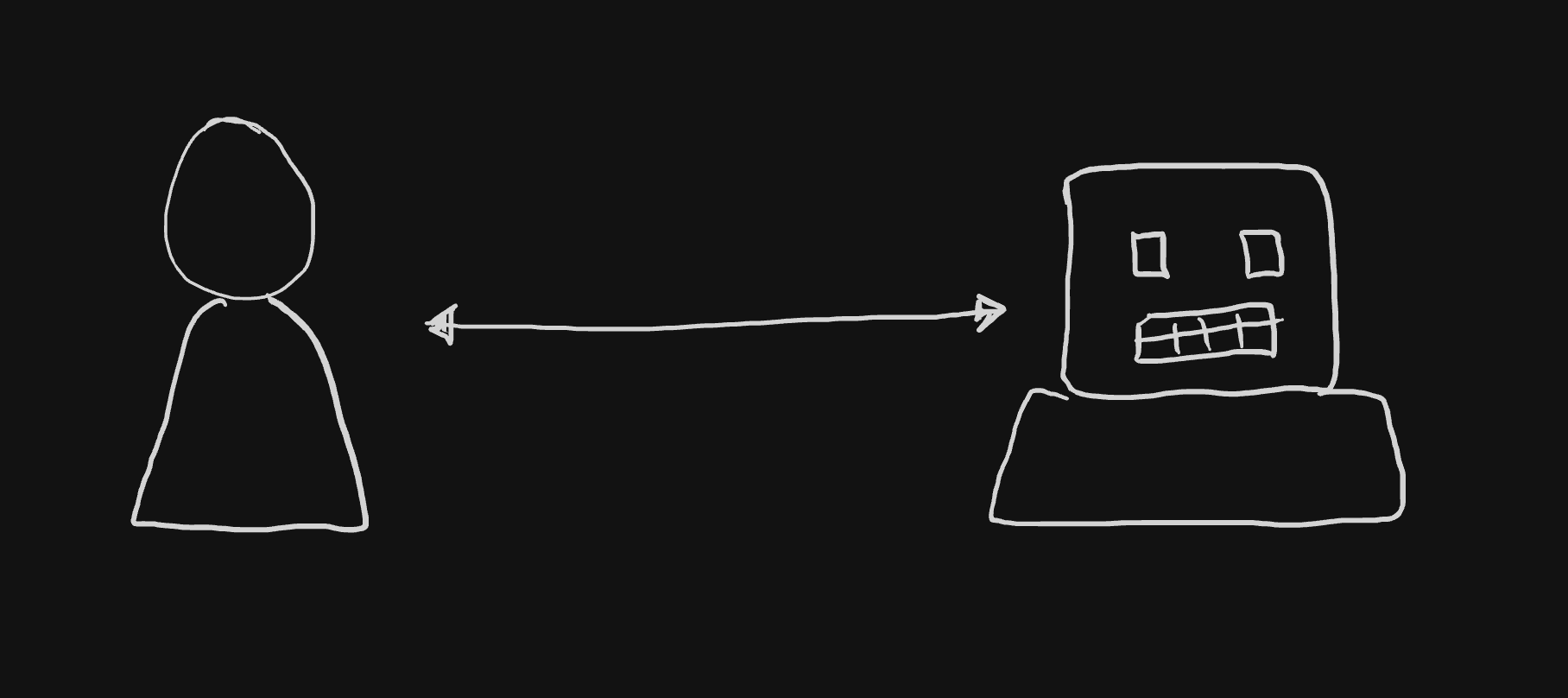
The simplest way I know to show it is a two-way arrow.
The drawing that wouldn't leave me alone
Midway through a live mentorship session with coaches, I drew a rough sketch on screen. A human on one side. A non-human on the other. A two-way arrow in between.
I looked at it and said, out loud, that everything we were talking about sat on that arrow. Keeping the person front and center. Making sure the connection was strong. I even said I might have to publish that one.
I meant it. The idea landed as something worth teaching beyond the call. So I did what I always do when that happens. I captured it into my Thinking folder, inside ideas, while the conversation was still moving. Not because I had two hours free to write. Because once it's captured, it doesn't get lost. It resurfaces when I'm ready to make something of it.
This post is that something.
The claim, plain
The connection between you and AI is context management. Not the prompt box. Not the model. Not whichever tool is winning this week.
The files you create are essentially that connection, that two-way arrow between you and the non-human. And that connecting line is where your Human Stack lives: five folders on your computer, with the files building up inside them.
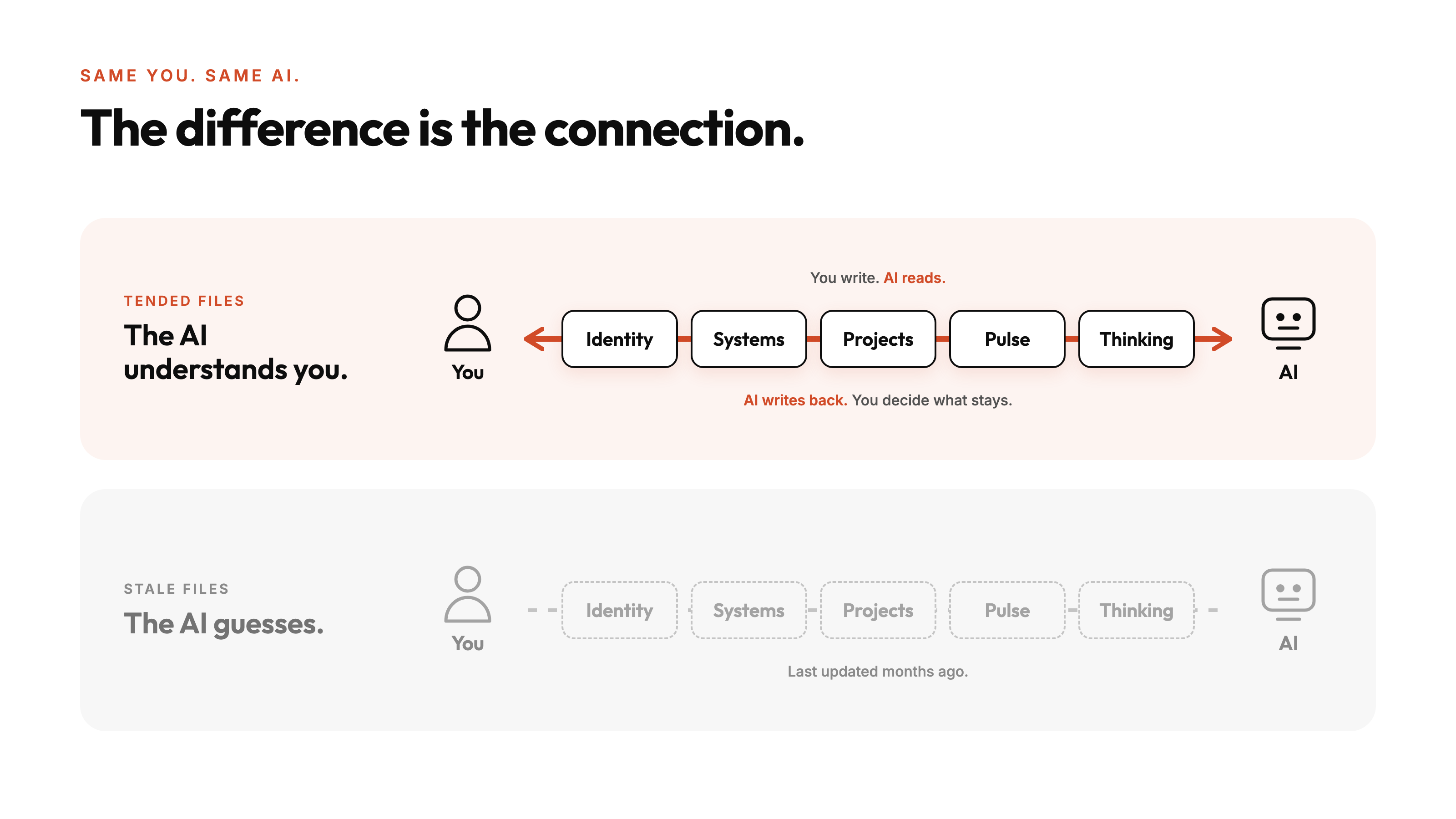
Tend those files and you get the full connection. Let them go stale and you get a dotted line. The AI still answers. It just guesses more. It fills in the blanks. And what comes back stops being the uniqueness that is you.
What most people still get wrong
Most people still treat the prompt as the skill.
I did too, for a stretch. We all did. It was all about prompt engineering: learn how to instruct the AI. What's true today is context engineering. With the right context I've abandoned the ACT prompting framework on many occasions. I just say, run the Now update. Update my week. And it works, because the files already hold who I am, how I work, and what matters now.
Take that context away and the same words won't work as well. The AI will guess. It'll get things wrong and fill in the blanks.
So the gold in all of this is your Human Stack. Your folders. Your system.
The model: You, the Human Stack, AI
Here's the simple picture.
You sit on one side. AI sits on the other. Between you sits the Human Stack: Identity, Systems, Projects, Pulse, and Thinking. Those five layers are the connecting line.
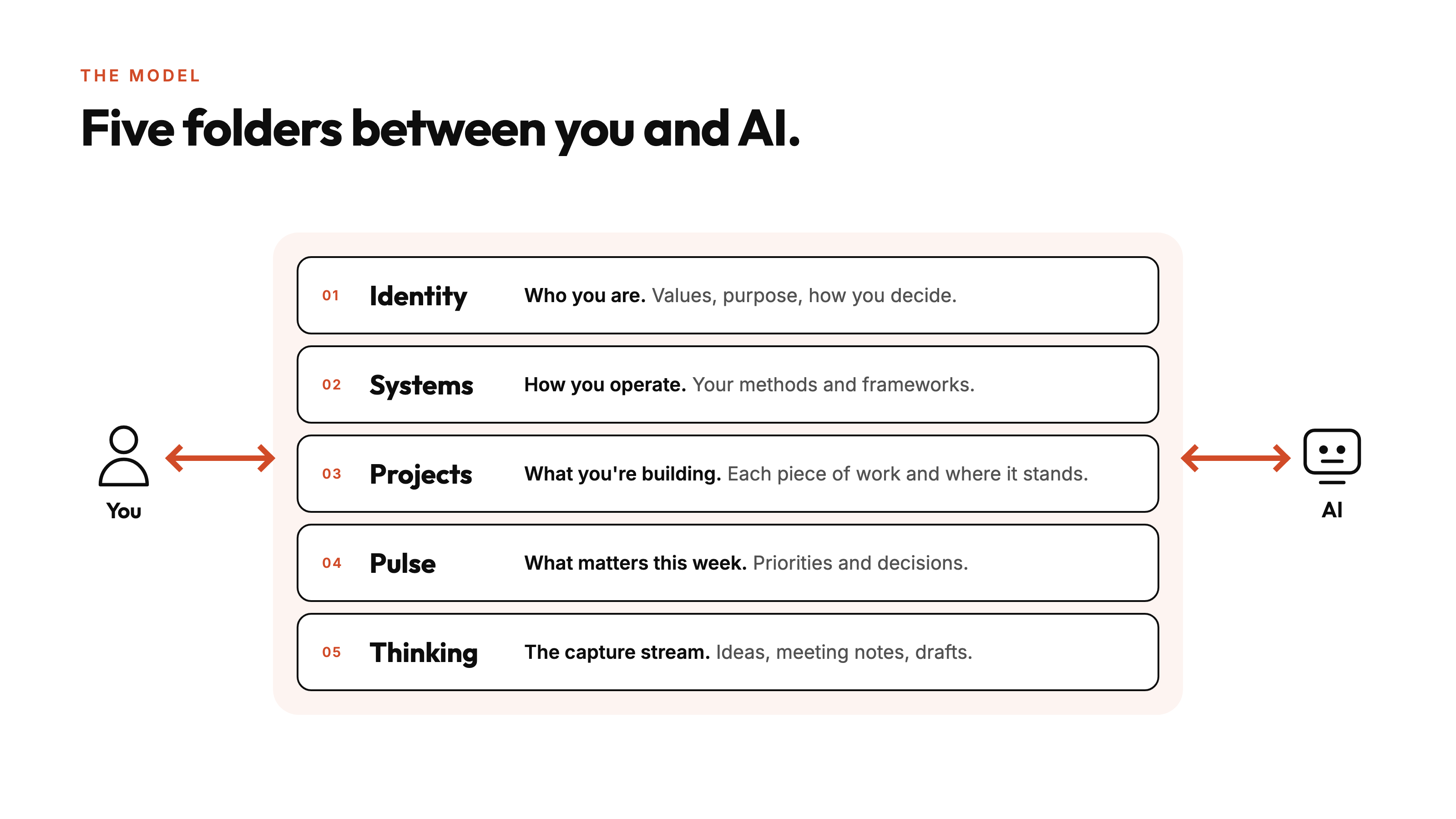
Identity holds who you are. Systems holds how you operate. Projects holds what you're building. Pulse holds what matters this week. Thinking holds the capture stream: ideas, meeting notes, drafts, the raw material that becomes everything else.
When those files are current, any AI can pick up where you left off. You don't have to retrain it. You don't have to re-explain yourself every session. It reads the files as part of its context.
When the files go out of date (and they do, the moment you drop them in a folder and walk away), the solid arrow turns into a dotted line. The work still happens. It just won't be as powerful for you.
If you've met the fuller model, Two Stacks, One Interface, this arrow is the simple picture of it. The Human Stack holds your files. A handful of Interface files tell the AI which ones to read. The AI and tools on the other side make up the Capability Stack.
Why it's two-way
The arrow points both ways for a reason.
One direction is obvious. You write to the files, and the AI reads them.
The other direction is the one most people miss. The AI writes back. At the end of a session, mine updates my Pulse file and the project I was working on. Each week it mines my ideas and meetings folders and brings me what it finds, for me to keep or bin.
Turn the Human Stack upside down and you can see that return trip. Raw capture lands at the top, in Thinking. What matters this week moves into Pulse. What belongs to real work settles into Projects. What works more than once becomes a method in Systems. Identity changes slowly, and only with your yes.
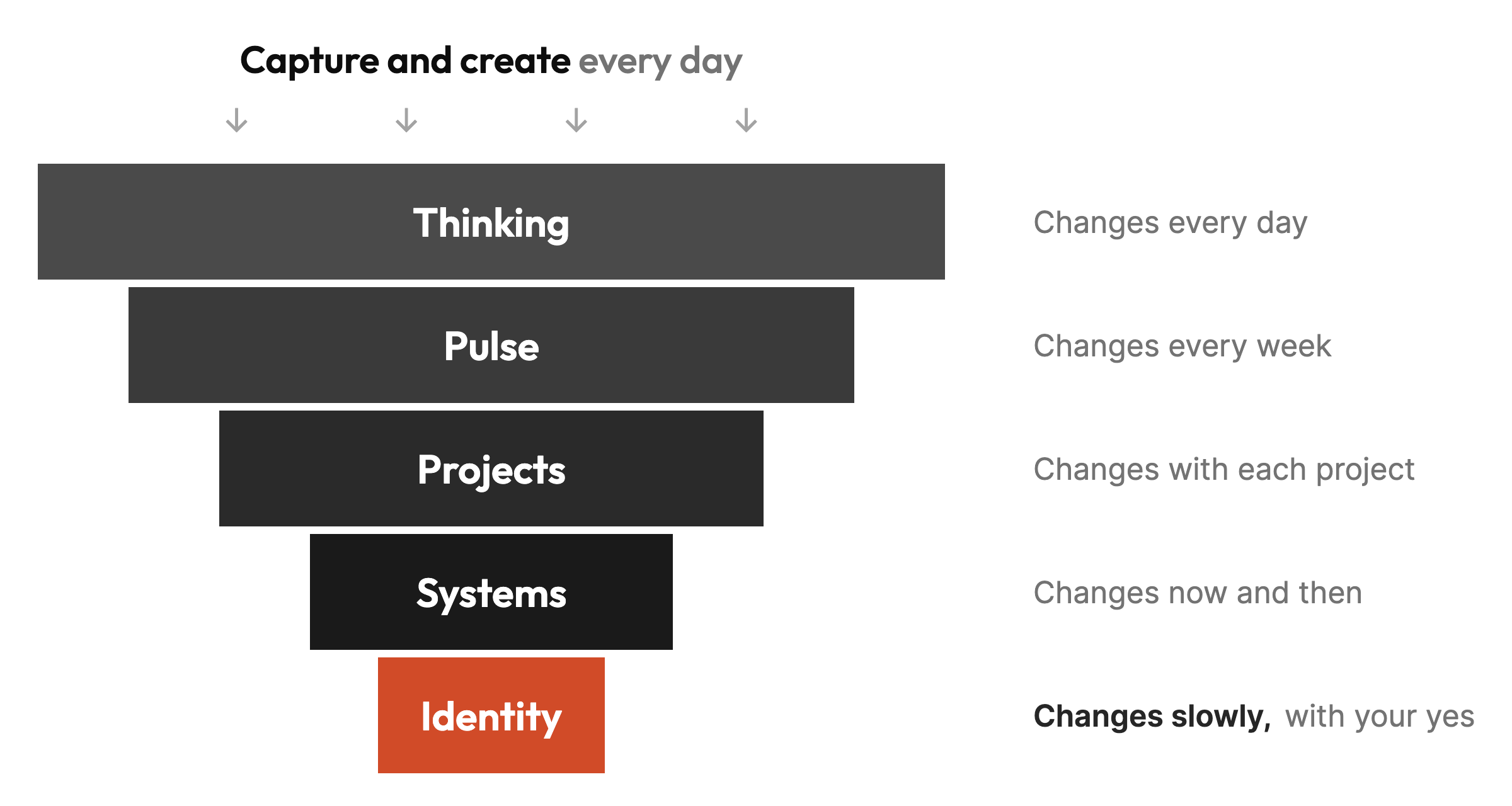
That's what keeps the line solid without turning it into admin. You capture. The AI helps tend. You decide what stays.
What a stronger connection actually changes
Three things show up fast once the connection is solid.
Continuity. The AI knows where you left off. A quick update at the end of each session, plus a living Pulse file, mean you don't start from zero every Monday.
Selective context. Your vault can hold a whole world without dumping everything into every chat. You point the AI at just the files the task needs. Identity and voice for writing. Project briefing for build work. Pulse for the week. Not the entire archive, every time.
Portability. Open the same Human Stack with a different AI and it still works, because the connection lives in the files, not in the tool. Point Claude at it. Point ChatGPT at it. Point whatever comes next at it. The context travels with you.
And through all of that: yes, we always want agency. Yes, we always want presence. And we always want the decision, where it matters. AI can help with plenty. The human stays at the control point.
Where ACT still fits
ACT (Act as, Context, Task) still earns its place. Assign a role, give Context, set the Task. When context is thin, clear instruction is how you stop the model grabbing a random book from the infinite library. Three words you can hold in your head.
What changes with a tended Human Stack is how often you need the full ritual. Rich context lets you drop into natural talk for the work you do every week. ACT is still there for new domains, cold starts, and anything where the files don't yet hold enough. Don't throw the framework out. Know when each fits.
How this post was made
This piece is also proof of the thing it's teaching. Here is the trail, step by step.
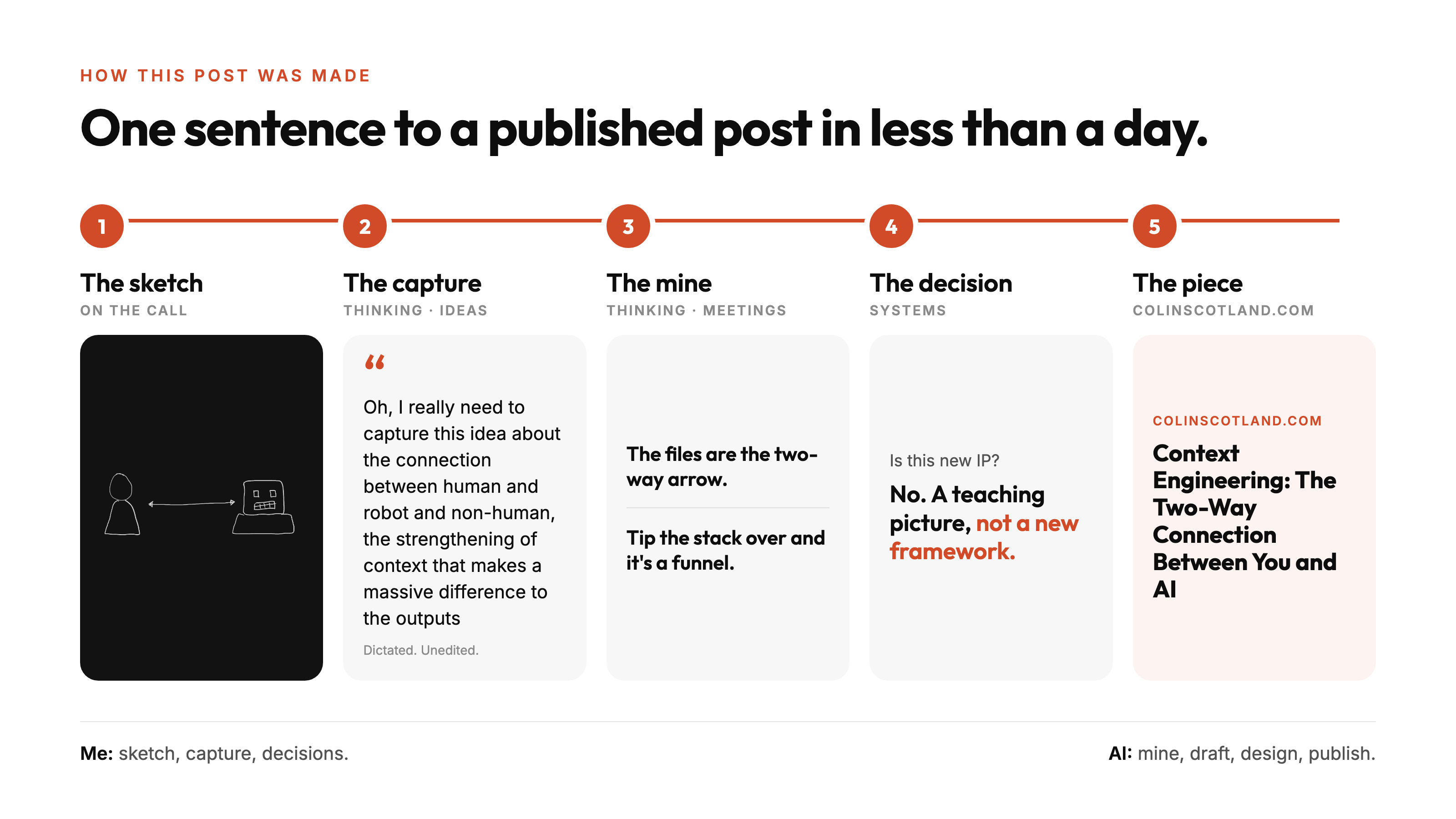
1. The sketch. On a live mentorship call with coaches. The rough drawing above.
2. The capture. While the call was still running, I dropped one line into the ideas folder in Thinking. This is it, unedited, as I dictated it:
Oh, I really need to capture this idea about the connection between human and robot and non-human, the strengthening of context that makes a massive difference to the outputs
That's the bar for capture. One messy sentence. No outline, no draft, no deciding where it belongs.
3. The mine. AI read that note alongside the notes from the call and pulled out the insight. The files are the two-way arrow. Tip the stack over and it's a funnel. The stronger the connection, the more the context shows in the output.
4. The decisions. We shaped it together, and I made the calls. One came after the first version of this post went live. Was this new IP? It isn't. It's a simpler way to teach a model I already use, so it went into my Human Stack notes as a teaching picture, not a new framework.
5. The piece. The draft was written in my voice, against my voice rules. The sketch went through a first AI draft that wasn't good enough. I sent it back, and it became the finished graphics in this post.
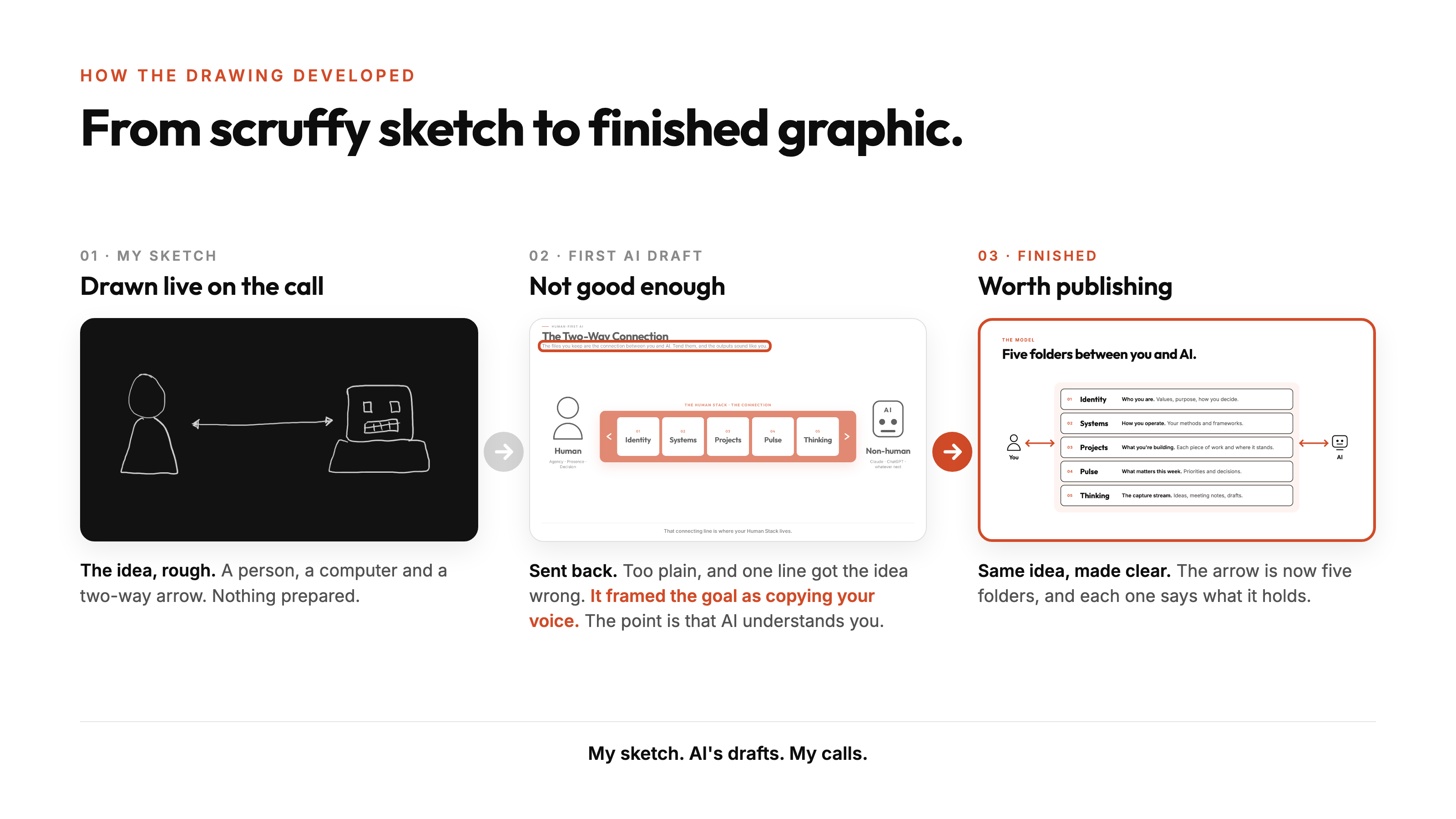
From one dictated sentence at 4:30pm on Wednesday to a published article on Thursday morning. Less than a day.
The idea and the words are mine. AI helped mine, draft, and design. I made the calls. That's the two-way connection doing its job: human at the center, files as the wire, AI amplifying the work without taking the decision.
FAQ
What is the two-way connection? A simple picture of how you and AI connect through context. The files in your Human Stack are the two-way arrow. You write to them, and the AI reads them and writes back. Tend them and the connection is solid. Neglect them and it becomes a dotted line where the AI guesses.
Is this just another name for prompt engineering? No. Prompt engineering is how you instruct the model in the moment. Context engineering is what the model already knows about you before you type.
Does this lock me into one AI tool? No. The connection lives in your files. Point any AI at the same stack and it can read who you are and how you work. You own the context. The tool is rented.
Do I still need a prompting framework like ACT? Yes, especially when context is thin or the work is new. With a strong Human Stack you can often talk in plain language for recurring work. ACT remains useful when the files don't yet carry enough.
Keep the connection strong
The work that compounds is building and tending the connection: the files, the habits, the selective context that lets any AI meet you where you actually are.
If you want the structure for those five folders, start with the Human Stack. If you want the three-word prompting framework for the days when context is thin, use ACT.
And if you want one practical insight each week on working with AI without losing yourself, join the Intelligence Briefing.
The files that we create are essentially that connection. Keep them alive.