The Task You Dread Is Telling You What to Automate
Everywhere you look right now, the message is the same. Automate. Build agents. You are behind. So you open a chat, ready to finally do it, and you go blank. The cursor blinks. There is so much it could do that you end up doing nothing with it at all.
The hardest part of using AI was never how it works. It is knowing where to point it. And the noise telling you to point it everywhere only makes the blank page worse.
I watched this happen with a coach in one of my cohorts. She keeps a separate space in her AI tool for each client, one box of notes per person. Every morning she wants a short briefing on the clients she is seeing that day. So every morning she opens each client's box, copies the notes, pastes them into a fresh space, and asks for the briefing there. As she put it, just thinking about it exhausts me. Is there a way for the AI to fetch that without me copy-pasting?
That question is the whole game. Not because the copy-paste is a big problem. Because of where it points.
You already know what to hand over
The blank-page version of this is "what could AI do for me?" It is a terrible question. It is too big and it has no edges, so it sends you browsing other people's clever use cases looking for one that fits. You come back with a list of things that sound useful and a nagging sense that none of them are yours.
There is a much smaller question that works far better. What do I do by hand, every week, that I resent doing? Not the work you love or the thinking only you can do, but the rote repetitive step in the middle that you would skip if you could. The thing you have done forty times and will do forty more.
That resentment is information. It is the most reliable signal you have, and almost nobody uses it on purpose. The task you dread is not a character flaw to push through. It is a spec, already written, waiting for you to read it.
Frustration is a spec
Here is what the coach's exhaustion was actually telling her.
She was treating her morning as an AI problem and feeling stupid that it was not solving itself. It was not an AI problem. It was a missing-part problem, and the part was named precisely by the bit she hated.
Think of any piece of AI help as a thing with four jobs. It can reason. It can hold your notes and your way of working. It can go and fetch and do. And it can wake up on its own and run without you asking. Most setups only have the first two. They think, and they hold what you have given them, but they sit there waiting for you to do the legwork and the remembering.
The copy-paste she resented was the legwork, the going and fetching from each client's box. That is a part her setup did not have. Having to remember to ask for the briefing every single morning was the remembering. That is another part it did not have. The exhaustion was not vague. It was pointing at two specific missing pieces with a steady finger.
The moment you name the missing part, "this is exhausting" turns into "I need it to fetch across all my notes, and I need it to run on its own at seven each morning." That is not a complaint any more. That is a brief. You can hand a brief to someone, or to something. You cannot hand over a sigh.
What this changes for you
You do not need to know how any of it is wired to use this. You need to know which part is missing, and the part you are missing is always sitting underneath the task you avoid.
So do this. Take one thing you do most weeks and dread. Pulling figures into the same report. Reformatting notes after every session. Chasing the same follow-up. Writing the same kind of message to a new person for the hundredth time. Pick one and look at what you are actually doing with your hands and your attention.
Then ask which part of it you wish would just happen. Is it the fetching, the gathering of stuff from different places? Is it the doing, the same change made every time? Is it the remembering, the fact that it only happens because you held it in your head? Whichever one makes you exhale is the part to hand over. Name it in a plain sentence. I want it to gather X from Y. I want it to run by itself on a Monday. That sentence is your starting point, and it is far more useful than any list of use cases, because it came from your own week instead of someone else's highlight reel.
Now you build it
That sentence is the start of a loop, not a leap. You do not need a course or a developer. You build the thing in the same chat window you already use, and it goes like this.
Brainstorm. Describe what you want in plain words and let the AI help you shape it. What it should pull in, and what it should hand back in a form you would actually use. You are done when you can say what it does in one sentence.
Test. Run it on a real example. Read what comes back. Tell it what is right and what is off, then go again. Three or four passes and the output starts to match what you pictured.
Schedule. If the work is regular, set it to run on its own. Seven each morning, every Monday, whatever the rhythm is. Now it wakes up without you.
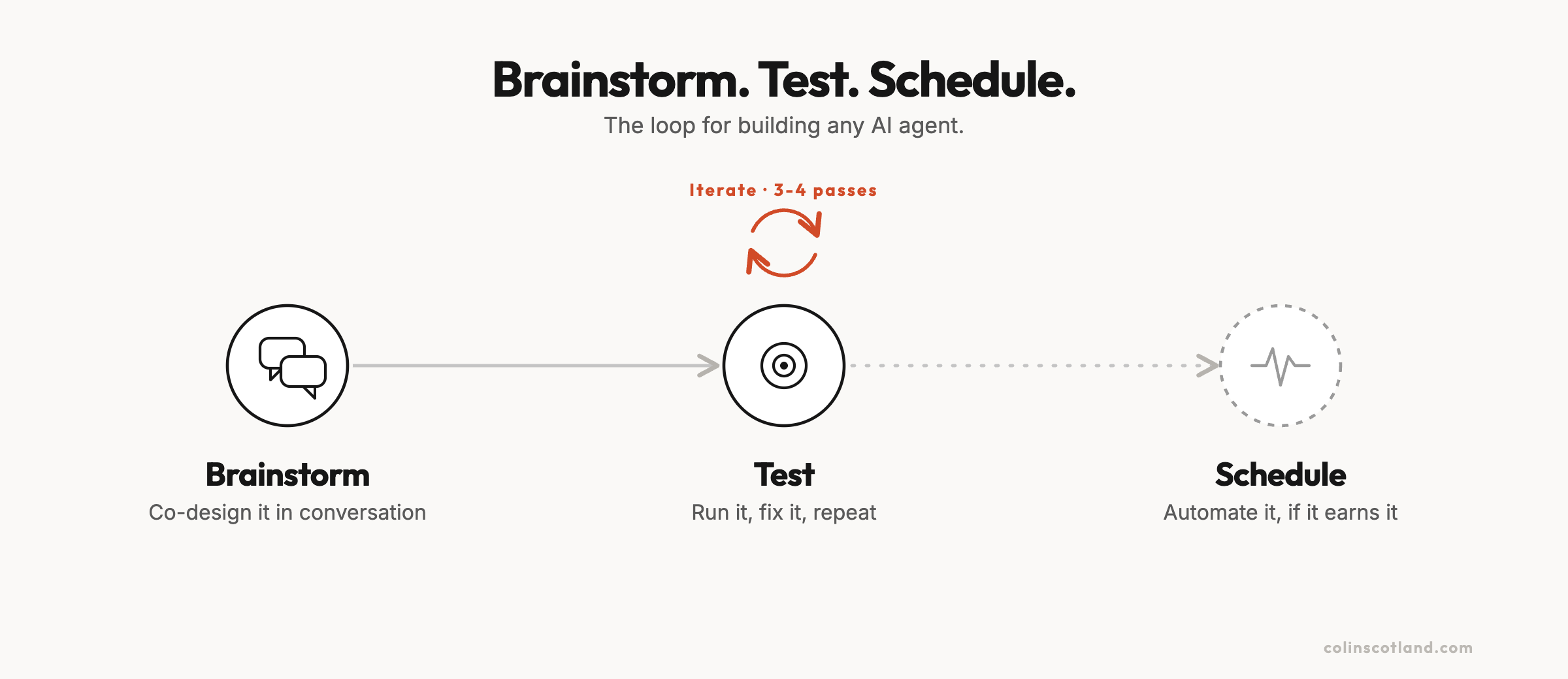
That last step is optional, and that matters. Most of the value is already banked by the end of Test. If the part you dread is the fetching or the doing, you fix it there and you are finished. You only reach for Schedule when the thing genuinely needs to run without you in the room. The dread told you which part was missing. It also tells you when to stop.
The promise of AI was never that it would do your work. It was that it would take the parts of your work that never needed you, so you can spend yourself on the parts that do. You find those parts not by dreaming about what is possible. You find them by paying attention to what you dread. The friction is the map. Follow it.